
Bitcoin first appeared more than 17 years ago. Since then, tens of thousands of cryptocurrencies, backed by tens of billions of dollars in venture capital, have tried to displace it. Yet, it has never been surpassed in value or security. Today, bitcoin not only remains the top cryptocurrency, but it is also worth more than all the others combined.
How did that happen? How did bitcoin baffle a generation of technologists who repeatedly tried—and failed—to dethrone it? And why is it still underestimated by investors? In my view, it’s because of a simple mental mistake: We tend to think about bitcoin as we would any other technology, when the more accurate mental model is to treat it as a network protocol. That distinction seems small, but it makes all the difference.
Most technologies are quickly disrupted. As soon as you build a mousetrap, it serves as a global invitation to build a better one. That’s why our natural intuition when encountering something like bitcoin has been to think of GeoCities or Ask Jeeves—grandfather technologies that paved the way but ultimately got replaced.
Protocols Don’t Compete Like Products
A protocol, on the other hand, is a set of standards that defines how tasks, communications or behaviors should be conducted. Analog examples include spoken or written languages, as well as common cultural behaviors such as handshakes and other action responses. Network protocols are more recent and include Internet Protocol (IP), Ethernet, Universal Serial Bus (USB) and Simple Mail Transfer Protocol (SMTP). Those emerged in the early days of the modern internet and are still going strong.
Network protocols, unlike most other technologies, are defined by their simplicity, robustness and gradual refinement in backward-compatible ways. They serve as backbone standards upon which more complex technologies can be built.
Imagine a steel frame that supports a building. It doesn’t change over the decades, or barely does—nor would we want it to. Now, imagine the interior wall designs, appliances, furniture, windows and curtains. Unlike the frame, those features are frequently swapped out for new and improved versions. It’s exactly the same with backbone protocols and the higher layers of technology built on top of them: Apps and hardware change out frequently, while the network protocol itself provides an enduring substrate for those changes.
Protocols are naturally protected by self-reinforcing network effects. Minimal improvements to Ethernet or USB can’t compete with the fact that billions of existing devices already use those protocols. And those protocols upgrade, but slowly and in backward-compatible ways. Only something dramatically superior could have a hope of outright displacement.
Lastly, protocols are mostly neutral. Nobody owns the concept of “framing” or “English” or “handshakes.” There is no governing body that updates them over time, even as they gradually change. The same is true for open-source and decentralized protocols. Contributors can improve them, but it’s ultimately a slow and decentralized process.
We tend to think about bitcoin as we would any other technology, when the more accurate mental model is to treat it as a network protocol.
Bitcoin emerged as free and open-source software—a network protocol that allows anyone with internet access to store and transmit value to others without relying on trusted third parties. It benefited from first-mover advantage and its creator disappearing early. Bitcoin then remained in power, thanks to the self-reinforcing network effect advantages of being the dominant protocol. Liquidity begat more liquidity, and proof-of-work security begat more security.
In this context, simplicity is a feature, not a bug. Bitcoin does one thing extremely well: store and send value on the internet. It’s not an all-purpose computer like some other blockchains. Complexity expands the attack surface and creates more governance debates, which is why it is best left for higher layers rather than built into the foundation itself.
In the early years, it made sense for technologists to challenge bitcoin as the backbone layer. But as time marched on, bitcoin has asserted itself through decentralized network effects as the neutral, purposely simple and surprisingly robust protocol of decentralized value and payments.
In a world dominated by centralized systems, currency debasement and global barriers, bitcoin proved valuable for its confiscation-resistant, debasement-resistant and permissionless global settlement. It is still the most liquid and secure way to store and transmit value without centralized middlemen or custodians, and that capability comes with a price.
What This Means for Investors
The question for investors is: What price? Bitcoin has already emerged as the dominant protocol of value, but how big is its market?
Bitcoin’s volatility comes from trying to answer that question. As competitors rise and fall, as governments ebb and flow in terms of their attacks and support and as concerns arise or diminish regarding its security against threats like quantum computers, its perceived value changes rapidly even as its functionality remains consistent.
Bitcoin started at zero. To grow into a network valued at many trillions of dollars, it requires upward volatility. But where upward volatility exists, it inevitably attracts speculators and leverage, and thus, bitcoin encounters periods of downside volatility as well. There’s no such thing as an asset that enjoys upward volatility without downside washouts. And that, ironically, weakens bitcoin’s use case for near-term savings, rendering it as a longer-term investment for many people during its adoption process. But if it’s to succeed, there is no other way.
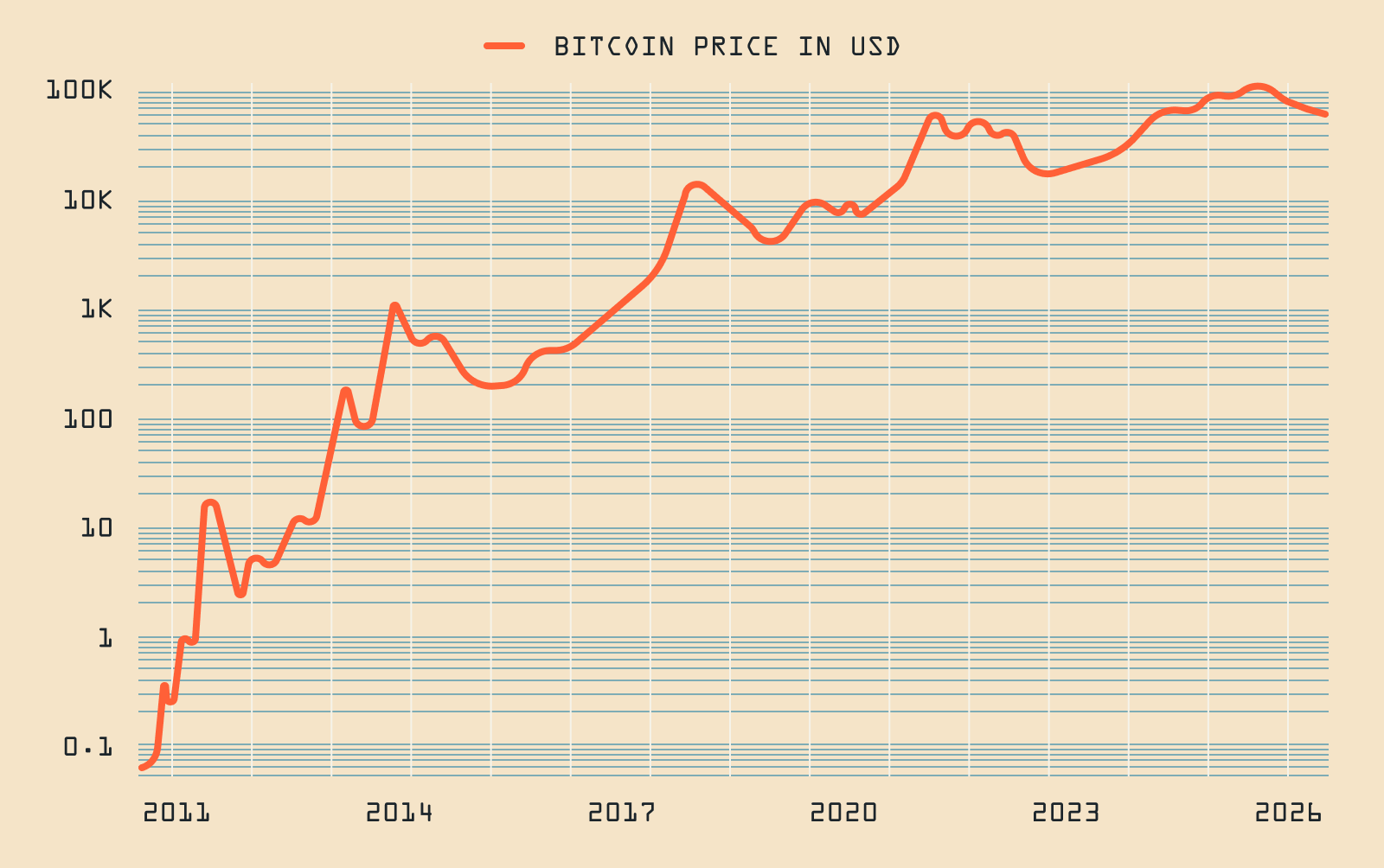
Bitcoin’s price has made a volatile series of higher highs and higher lows as adoption has grown. Only when it is nearer to its total addressable market size might its volatility meaningfully diminish, which could then further boost its ability to be used as near-term savings, and thus further increase its demand and usefulness.
Right now, the bitcoin network is valued at less than 0.3% of global liquid assets collectively worth more than $500 trillion, according to research by McKinsey. In a world of decreasing trust, I would contend that a permissionless, debasement-resistant, confiscation-resistant and globally portable liquid asset is worth at least an order of magnitude more than that in the long run—which is still a tiny share of roughly 3%—as long as it continues to remain decentralized and secure.